Kumbh Abhishekam — Restoring the Divine Pulse
Rittvik
Golaghat, Assam
The Kumbh Abhishekam unfolded as a sacred day of renewal — a reaffirmation of devotion, continuity, and living divine presence. Each stage flowed naturally into the next, moving from invocation to consecration and finally to shared blessings.
The day began in a spirit of devotion and gratitude. Revered Sree Guru Maa was received with loving respect, and fragrant flower garlands were offered as a mark of welcome and reverence. The Purṇa-Kumbh was then offered, invoking Auspiciousness and fullness at the sacred commencement.
Vedic chanting gently filled the atmosphere, creating a calm and focused space for the ceremony. Chaitanya ji sounded the opening Shankh-naad, and with that resonant call, the sacred proceedings formally began. The gathering then proceeded to the Sree Ishwar Darshan Temple.
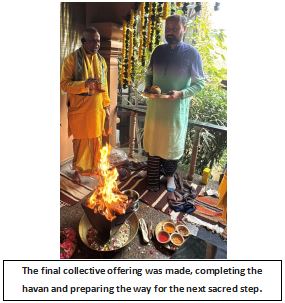
Inside the temple premises, before the sacred Vigraha of Sree Hanuman ji, the sacred Fire was lit. The Havan was conducted by learned pundits who chanted the Vedic mantras and performed the rites with discipline and devotion. Beautifully decorated Kalash stood nearby, adorned with coconut, mango leaves, flowers, and sacred threads. Each Kalash had been invoked with Mantra and prepared to receive and hold the Divine energy for the final consecration.
Offerings of fruits, flowers, grains, turmeric, sandal paste, lamps, and copper vessels were arranged carefully. These symbolized surrender — offering our actions and their fruits back to the Divine.
Before each oblation, the remembrance “idam na mama” was made — “this is not mine”. Then, with “Svaha,” the offering was placed into the sacred fire.
As the havan reached its intensified phase, the flame rose high and steady. Smoke ascended gently, Mantras continued in rhythm, and the priests remained fully attentive around the Havan kuṇḍ. The sacred Vigraha of Sree Hanuman ji stood as silent witness to the proceedings. The atmosphere felt focused and powerful — prayer gathering into consecration.
Abhiṣhekam then commenced. Revered Sree Guru Maa, along with Chaitanya ji, offered sanctified dravyas over the Deity — water, milk, curd, ghee, honey, and other sacred substances — each poured with Mantra and devotion. The sacred streams flowed over the Murti and collected below as Teerth. The Abhiṣhekam represented purification, grace, and renewal.
Devotees were then invited to participate. One by one, with folded hands, Abhiṣhekam was offered. The sanctified waters passed through many hands, making the ritual a shared act of Bhakti. The Maha-Abhiṣhekam continued in uninterrupted flow, refreshing the Sanctum and all present.
At this sacred moment, Guru Maa explained the deeper meaning of Kumbh Abhishekam. A temple consecrated through Praaṇ - Pratiṣhṭha becomes a living centre of Divine presence. Over time, restoration is natural, and Kumbh Abhishekam renews and re-stabilizes the subtle Spiritual energy of the temple. Fifteen years had passed since the Prāan - Pratiṣhṭha in 2010 — completing a sacred cycle.
The temple Kalash, respectfully restored and reinstalled, contained fresh Navadhanya placed with mantra, symbolizing harmony with the Navagrahas. The Navadhanya installed fifteen years earlier, having absorbed years of worship and sacred vibrations, were distributed as prasaad to all present to be kept at home sanctifying them.
Sacred waters from the Panchatarini rivers — Ganga, Yamuna, Godavari, Narmada, and Kaveri — were invoked for the Abhishekam. Saraswati ji was invoked through Scriptural wisdom, and Sindhu symbolized the union of all sacred waters, making the invocation complete in spirit.
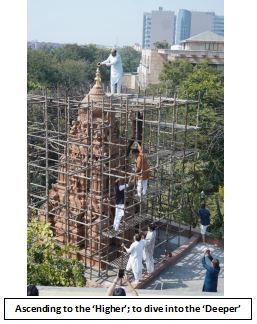
Then came the most awaited moment. The energized kumbh-s were carried reverently to the temple Shikhara. At the appointed time, the sanctified waters were poured over the Kalash at the summit. The waters flowed down over the temple structure, marking the formal Kumbh Abhishekam — the renewal of the temple’s Spiritual life-force.
Deity was then dressed in new vastram and adorned beautifully. Ārati was offered, filling the Sanctum with light and devotion. Pradakshina followed, as all moved around the Sanctum in quiet reverence, inwardly aligning with the newly re-energized centre. Blessings were received from Sree Guru Maa, completing the sacred atmosphere with grace and gratitude.
Teerth, prasad, and annadaan were then offered to all. The Panchatarini Teerth and the earlier sanctified Navadhanya were shared as blessings. What had been invoked and renewed within the Sanctum now flowed outward as sacred nourishment for everyone.
Finally, as the sacred day drew to its close, Chaitanya ji performed the concluding Shankh-Naad. The resonant sound marked the formal completion of the Kumbh Abhishekam.
Thus, the entire ceremony unfolded as a living expression of Bhakti, surrender, renewal, and grace — restoring the Divine pulse of the temple and strengthening the faith of all who gathered.
This unique and auspicious memory will always remain close to my heart.
My pranaam at the Holy Feet of Sree Guru Maa,
My pranaam to Chaitanya ji,
Hari Aum.